
Heard Island: The ill-fated Antarctic voyage that helped launch Australia’s polar science era
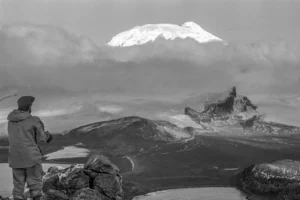
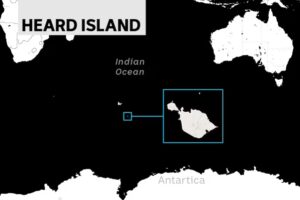
Seventy years ago, a small team of scientists set sail toward one of the most remote places on Earth: Heard Island, a rugged, wind-lashed territory in the Southern Ocean. Measuring just 368 square kilometres and dominated by the towering active volcano Big Ben, the island sits far south of mainland Australia—closer in spirit to Antarctica than anywhere inhabited.
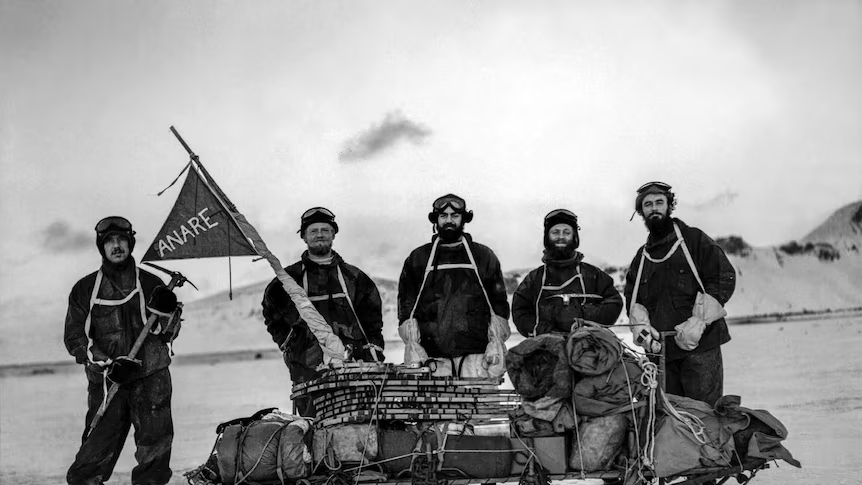
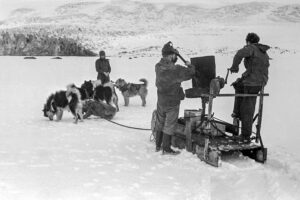
The expedition was ambitious. A 14-man crew planned to establish a temporary scientific base and spend the winter documenting one of the least studied environments on the planet. Their goal was simple but difficult: gather data, map the terrain, and better understand a region that was still largely unknown to science.
But the mission was quickly tested by the environment itself.
Just a week after arrival, extreme winds reaching up to 200 km/h destroyed the expedition’s amphibious aircraft. That single loss crippled a key part of their plan—particularly aerial photography of Big Ben, which was central to mapping and geological study.
Despite this setback, the team continued their work on the ground, establishing a temporary camp under some of the harshest conditions on Earth. What they encountered would leave a lasting impression on those involved and on Australian science more broadly.
A place of extremes: beauty and danger side by side
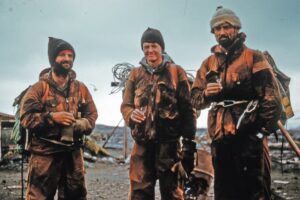
Professor Grahame Budd, one of the expedition members who later returned to Heard Island multiple times, described the environment as both stunning and unpredictable.
He noted that the island seemed to shift constantly between serene landscapes and sudden, violent weather conditions. One moment could bring calm, almost surreal beauty; the next, life-threatening storms sweeping in from the Southern Ocean.
For those who experienced it firsthand, Heard Island was not just remote—it was actively hostile.
Budd himself first arrived in 1954 as a medical officer and expedition leader. Like many newcomers to the Southern Ocean, he was immediately confronted by the physical toll of the journey.
Extended seasickness, rough crossings, and isolation were part of the cost of reaching such a location. But for Budd and others, the scientific value outweighed the hardship.
The beginning of Australia’s Antarctic research program
Although the 1947 expedition faced serious challenges, it became a foundational moment in Australia’s scientific presence in the Antarctic region.
It directly contributed to the formation of the Australian National Antarctic Research Expeditions (ANARE), which would go on to become the central body coordinating Australia’s long-term polar research efforts.
According to ANARE Club representatives, this early mission marked the start of Australia’s sustained post-war commitment to Antarctic science—a shift from occasional exploration to structured, ongoing research.
What began as a difficult field expedition eventually evolved into a national scientific program that continues today.
Why Heard Island matters scientifically
Despite its isolation and lack of permanent human settlement, Heard Island remains an important location for climate and environmental research.
Scientists value it because it acts as a highly sensitive indicator of environmental change. Its glaciers respond quickly to shifts in temperature and climate conditions, providing a natural record of long-term environmental trends.
The island’s geography is also unusually diverse for its size. It contains glaciers at different elevations and orientations, creating multiple microclimates that react at different speeds to global warming. This makes it especially useful for studying how climate change unfolds across time and terrain.
Researchers also emphasize its ecological significance. The island hosts a mix of Antarctic and sub-Antarctic ecosystems, including unique vegetation and wildlife adapted to extreme conditions.
A living memory of early exploration
Now in his 90s, Professor Budd remains closely associated with Heard Island, reflecting on it as both scientifically valuable and deeply memorable.
For him and others who participated in the early expeditions, the island represents more than just a research site. It symbolizes the beginning of a broader national effort to understand Antarctica and the surrounding Southern Ocean.
Members of those early missions recently gathered in Melbourne to mark the anniversary of the original voyage, reflecting on how much polar science has evolved since those first difficult steps.
A legacy that continues
Australia no longer maintains a permanent base on Heard Island, but it continues to conduct periodic scientific visits. The region remains a key reference point for understanding climate systems in the Southern Hemisphere.
For scientists who first braved its conditions decades ago, the island still holds a powerful meaning.
It stands as both a reminder of how fragile early exploration efforts were—and how they laid the groundwork for decades of Antarctic science that followed.